by Miles McCanles
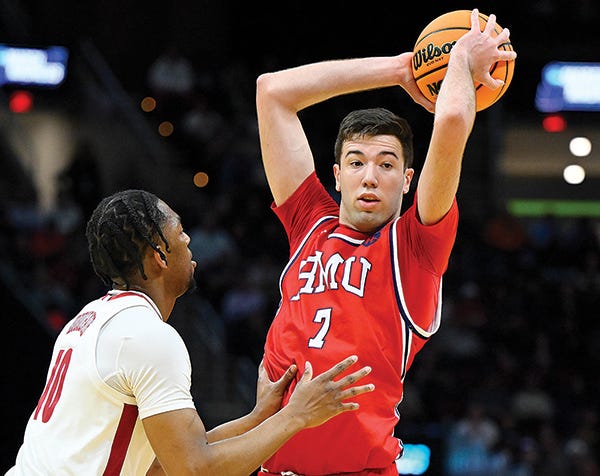
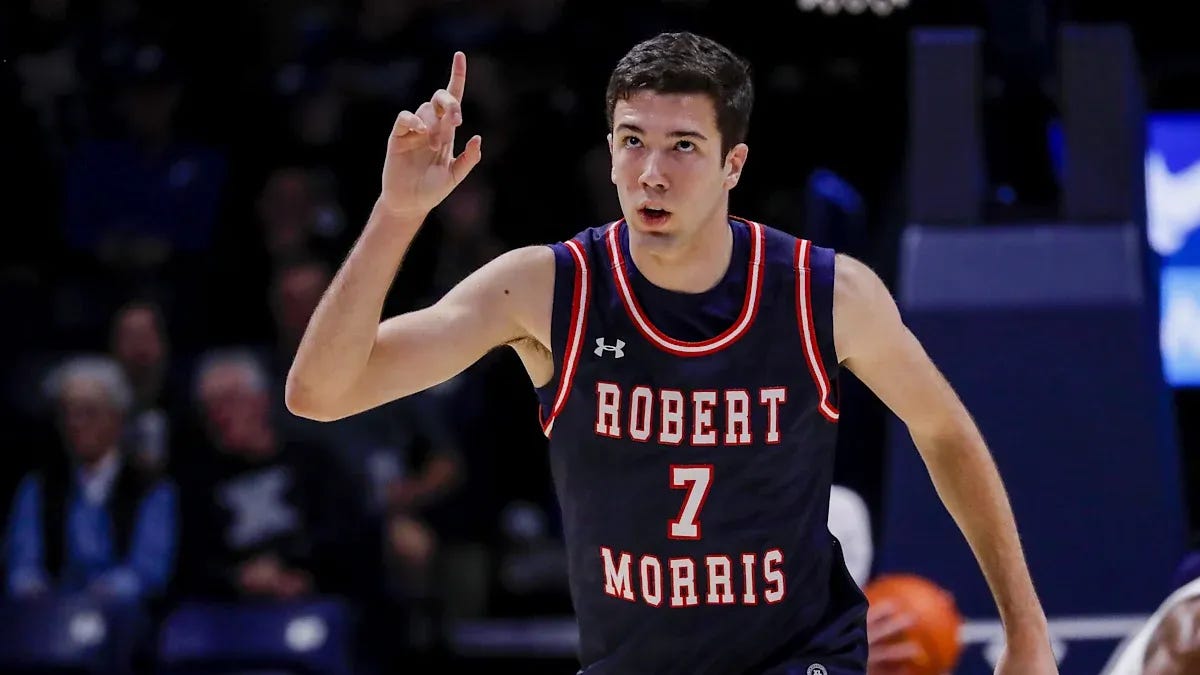
At 6’9 and 215lbs, Alvaro Folgueiras burst onto the scene this past season. After a quiet freshman campaign that saw the Spaniard play just 44% of his team’s minutes, Alvaro’s sophomore season propelled him to win Horizon League Player of the Year and lead the Robert Morris Colonials to the NCAA tournament. By late March, Folgueiras would enter the portal, and to no surprise, he’d quickly become a coveted target. Just a month later, he had found a new home in Iowa City under first-year head coach Ben McCollum. With the Hawkeyes entering this new era, it’s clear that Folgueiras will need to be a key piece, and I believe he’ll answer the bell.

Offense
Folgueiras is a fluid and versatile offensive player regardless of his athletic limitations. While his role at Robert Morris led him to the second-highest usage rate on the team, he still has great off-ball ability, as shown by his success in both the pick-and-roll and spot-up scenarios. As Folgueiras now transitions into the Big Ten, the real question surrounds what role Alvaro can fit into. Will he continue to expand his perimeter game and ball-handling ability as a big wing? Or will he adapt his physicality level to that of the Big Ten and make plays out of the post as he did at Robert Morris?
Shooting
Alvaro can score from all parts of the floor and demonstrates a shot diet that is economical in basketball’s scoring economy. With close to 35% of his shots coming from 3 and 42% coming at the rim, Folgueiras earns his keep through the two most efficient routes. As a shooter, he demonstrates a quick trigger that comes in useful during the abundance of spot-up scenarios he sees. Shots off movement have seldom come Alvaro’s way, but his handle and mechanics are encouraging signs for it to be an added element. Looking at his overall three-point volume, Alvaro saw little change between his freshman and sophomore years at 7.2 and 6.2 3PA per 100 possessions, respectively. Regardless, Folgueiras still managed to significantly improve his three-point efficiency, increasing his freshman mark of 30% to 41% for the 2024-2025 season. It will be key to monitor if his jumpshot maintains this trajectory, but his smooth mechanics and free-throw efficiency (79%) may be indicators of continued success.
Rim Scoring
It’s no coincidence that, as 42% of Folgueiras’ attempts have come at the rim, the region is the centerpiece of his game. Alvaro can create out of all regions of the post and create an abundance of second chances for his team through offensive rebounds. Whether he’s facing up a defender and driving out of the high post or doing a classic backdown on the low block, he displays a myriad of ways to get the job done. Out of all of these made looks, 55% were assisted, making the other 45% result from unassisted creation. These numbers display a great balance between this self-creation, while also displaying play finishing that make his scoring adaptable to different lineups. While Folgueiras will play with an elite point guard next season in Bennett Stirtz, it will be key that he can create his own shot when Stirtz is off the floor. The numbers tell me he’s capable, even with the jump in competition.
Playmaking
Folgueiras is a high-level processor of the game that can identify advantages as he creates them. With his continued success in the post, he’s no stranger to drawing in extra defenders on the catch or the drive. Generating gravity with the ball in his hands is already a valuable skill, but what impresses me about Alvaro is how often he can anticipate these instances. Whether it’s kick-outs to a spot-up shooter, finding the cutter, or dumping the ball down to a teammate in the dunker’s spot, Folgueiras’ vision knows no bounds. Regardless, some concerns still arise. Even with an assist percentage of 21.9% which was only reached by 19 players who were 6’9 or taller, Folgueiras ranked near the bottom of that group in turnover percentage. At a turnover percentage of 19.9% and an assist-to-turnover ratio of just 1.4, Alvaro’s ball security was a bit underwhelming considering the mid-major competition he faced. With him only facing better competition going forward, this will certainly be an area to monitor.
Defense
I hold the opinion that defense is primarily a mental game. While athleticism and positional size certainly extend the range of skills a player can ultimately possess, scheme and motor are more than enough to form the numbers that make one a serviceable defender. Alvaro has the necessary motor, a rising star coach in Ben McCollum, and the added benefit of positional size, leading me to believe in his abilities as he jumps to high major ball.
Stock Creation
Defensive playmaking is an integral part of any good college defender’s game and a necessary trait for any NBA player’s survival. Alvaro more than passed the test in this category during the 2024-2025 season. With a steal rate of 2.8% and a block rate of 4.2%, Folgueiras was one of only twenty-nine players in the country to hit these thresholds. It’s true he didn’t wow many with his athleticism en route to these numbers, but he positions himself well to make plays on the ball, and that skill is invaluable. Positioning is a skill derived from one’s basketball IQ, and as Alvaro blocks most of his shots by staying vertical and using his reach, he’s clearly a smart defender.
Positional Size
As the tallest player on Robert Morris with an offensive game that had a heavy diet of post-ups, many would assume Folgueiras is just an undersized center. In reality, as he transitions into the Big Ten, that is far from the role he will need to play. Alvaro is a true stretch four that could easily fall into that “big wing” category with increased slashing and ball handling prowess on offense. Consequently, Alvaro should then be expected to guard opposing 3s and 4s and take advantage of the size advantage he has. At 6’9, he is in the upper echelon of wing sizes, and with a wingspan that appears to be a positive, Folgueiras can leverage his dimensions to bail him out in many cases where his foot speed and stance may be weak.
Concerns
Even as this report has spent much of its time covering the good things in Alvaro Folgueiras’ game, inevitably some red flags occur. As is the case with any player making the leap from mid to high major competition, weaknesses become even more apparent. If you can’t do x, y, z in the Horizon League, how can I expect you to figure it out in the Big Ten? This is not to say Folgueiras needs to be perfect, but rather that the margin of error is much smaller in his scenario. Nevertheless, I don’t foresee Folgueiras’ weaknesses to be the type of ones that cut him out of a rotation, but just ones that lead to an adjustment of his role. His lower physicality may just require him to carry a heavier perimeter role on both ends, while his limited athletic tools will only limit the range of players he can match up with defensively
Role Projection
Looking at Folgueiras’ Robert Morris film and statistics, he strongly resembled Danny Wolf to me. However, I think his role at Iowa will need to differ drastically from what Wolf’s was in his one year at Michigan. While Wolf was a 4 or 5 and the primary ball handler, Alvaro projects to be a 3 or 4 and the primary roll man.
Folgueiras offensively will eat on the perimeter by hunting open space as a spot-up shooter, at the rim as a play finisher in the pick-and-roll, and as a playmaker through dribble hand offs and attacking the short roll. Overall, the role’s key difference is that it will likely pull him away from the heavy diet of post touches and turn him into a clear stretch four.
On the defensive end, Folgueiras will choose the more favorable matchup between the opposing 3 and 4. The matchups will have to consider his slower foot speed and taller stance while playing into the strengths he has in his reach and rebounding ability. With true bigs like Oscar Cluff (Purdue) and playmaking wings like Andrew Rohde (Wisconsin) running around the Big Ten, Folgueiras will have to match up with an archetype between these two ends of the spectrum.
My Thoughts
I firmly believe Alvaro Folgueiras is an NBA prospect. With a great shot diet, the ability to create rim looks, and a three-point shot with even more room to grow, I’m very optimistic about his offensive game. The playmaking and defense are areas that I’m not sure I buy quite yet, but that’s exactly why I feel the jump to Iowa is good for him. If Alvaro can still create steals and blocks at a good rate in the Big Ten while maintaining his playmaking capabilities, I may be all in. He will still be the second-best prospect on his team (Stirtz) unless some other-worldly leap is taken, but I wouldn’t rule out Alvaro being a guy that could sneak his way into the end of the first round by the time we get to the 2026 draft.