Author: mfmccanles

  • Back from the Dead: Houston shocks Kansas in the Final Minute(s)

    By: Miles McCanles

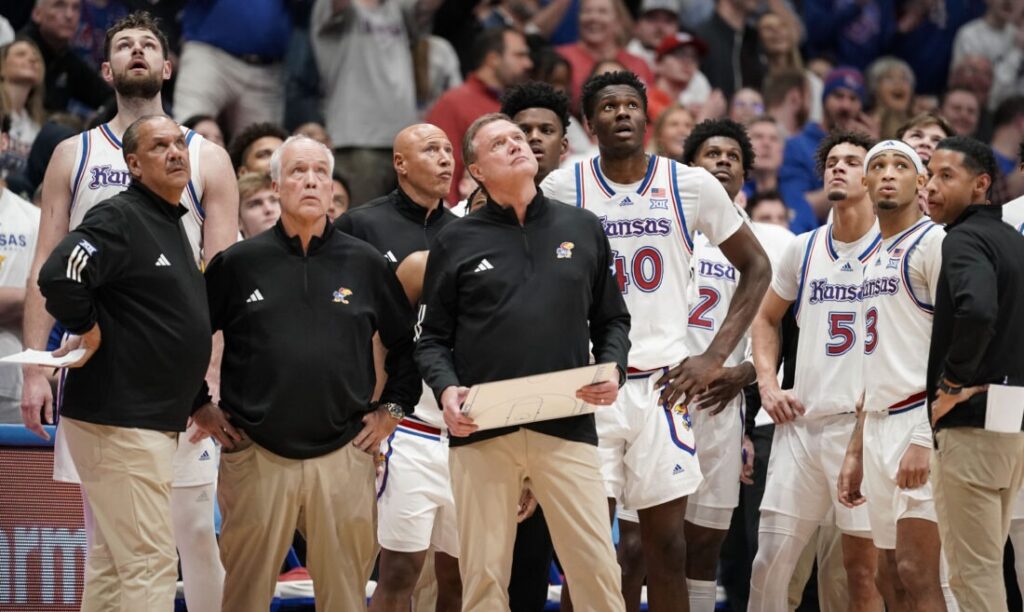
    Photo by Nick Krug / Lawrence Journal-World

    Allen Fieldhouse erupted as freshman big man Flory Bidunga threw down a monstrous dunk with 1:31 remaining in regulation. The Jayhawks had jumped to a 66-60 lead, and the game was all but over. However, the Houston Cougars had a 16-game regular-season winning streak in the Big 12, and they weren’t gonna quit.

    Cougars point guard Milos Uzan would get a bucket after a timeout, and they would quickly claw back. Houston’s big man, Jojo Tugler, would use his 7’6 wingspan on the inbounder, forcing back-to-back turnovers en route to two Houston buckets. In the blink of an eye, we had overtime in Lawrence.

    Up to this point, the game had been neck and neck as expected. While both teams found near identical success in the paint and from the three-point line, they shared struggles from the free-throw line.

    Flory Bidunga and reserve Rylan Griffen starred for the Jayhawks, both arguably having their best performances of the season thus far. Meanwhile, Houston shared the same recipe, finding success through their big J’Wann Roberts and guard Mylik Wilson off the bench.

    40 minutes of back-and-forth basketball would now come down to the extra period, and just 5 more minutes of play.

    The overtime period would prove to be a duel of familiar faces. Buckets from Bidunga and Griffen would push Kansas ahead, while J’Wann Roberts would keep Houston afloat. Nevertheless, Houston would find itself in a similar scenario. 

    Kansas held a 6-point lead, this time with merely 18 seconds remaining and two chances at the free-throw line to put the final nails in the coffin. Houston had battled and battled, but it didn’t appear to be enough. The streak that had spanned two seasons was about to break, right? Not quite.

    DaJuan Harris would miss both opportunities at the charity stripe, and the Cougars again had life. Milos Uzan would again bolt up the floor, floating over the boundary line under the hoop as he dished the ball to guard Emmanuel Sharp. With a hand in his face, Sharp would miraculously cut the lead in half with a deep three. 7.5 seconds remained.

    A familiar foe now appeared for Kansas: the inbounds pass. Houston would again call on Tugler’s wingspan as the intimidation factor against Kansas inbounder Zeke Mayo. Mayo would scramble along the baseline, looking like a quarterback rolling out of the pocket. The count was creeping towards 5, and he was running out of options. 

    Mayo panicked and floated the ball towards Kansas’s tallest player, Hunter Dickinson. Uzan would deflect the pass, and it would fall right into the hands of the aforementioned standout Mylik Wilson. Wilson had been scoreless in overtime, but it didn’t cool him down. He let it fly almost immediately, splashing a three and tying the game with 4 seconds left.

    Lightning had struck twice for Houston, and we needed another period of basketball.

    The second overtime period began, and immediately, Houston didn’t want to leave any doubt. After nearly tasting defeat twice down the stretch, the Cougars would take the first lead and never relinquish it. Two Emmanuel Sharp free throws would give Houston an 8-point lead with 24 seconds remaining, and Kelvin Sampson’s squad could finally taste victory.

    At last, the final buzzer had sounded, and you could hear a pin drop in Allen Fieldhouse. 

    The energy had been sucked out of the building after what was an instant classic of a game. As Kansas collapsed in crunch time of back-to-back periods, Houston’s streak stayed alive, in what may have been its most heroic effort yet.

    The game moves the Cougars to 16-3 overall and 8-0 in the Big 12. Houston will continue its road trip next Wednesday as they’ll head to Morgantown to take on the West Virginia Mountaineers.

    On the flipside, the loss drops Kansas to 14-5 and 5-3 in the Big 12. The Jayhawks will look to get back in the win column next Tuesday as they’ll defend homecourt against the UCF Knights.

    Overall, this episode of the biannual series between Houston and Kansas is firmly in the running for the game of the year in college basketball. That said, the rematch set for early March ought to garner loads of national attention as Kansas travels to Houston.

  • Cheerleader by Day, Bartender by Night

    By: Taylor Larsen

    It’s bar close at Whiskey Jacks Saloon on State Street, and the floor is sticky. Security is pushing out the last group of people who swear they “know the owner.” The music is still blaring for how late it is, and behind the bar, UW cheerleader Shayla Schulz is doing dishes and wiping down the counter where multiple drinks were spilled.

    Most students go to the bars to escape the stress of college. Schulz clocks in. And she does it knowing she has to be at lift at 6 am.

    Schulz is living a double life that most students wouldn’t survive a week. At Wisconsin, she is a D1 cheerleader who spends her mornings tumbling, lifting, stunting, and spending hours in Camp Randall, the Kohl Center, or the Field House supporting the Badgers. But she’s also a bartender at one of Madison’s busiest student bars, working nights that can stretch until 4 a.m., long after her classmates have gone home. Her teammates joke she’s insane. She usually agrees. 

    Shayla didn’t grow up thinking she’d be this person. She was a dancer before anything else. Cheer came after COVID when she was entering high school, trying to figure out how to socialize again, and tried out for her school’s team, just hoping to find something that felt normal. 

    She ended up being good at it. Then better than good. She grew up going to Badger games, so Wisconsin was always her dream school. Eventually, cheering at Wisconsin became a real possibility. Now she’s here, and she’s paying for it in more ways than one. 

    A typical day for Schulz is a puzzle of timing and sacrifice. She’s out the door at 5:30 a.m. to get to weight training. Classes take up her entire midday. She fits homework and chores into random windows of time…when she’s lucky. Evenings are either practice, home games, or shifts behind the bar. 

    “I’ve had to find routines and certain times of the day to do certain things, otherwise they simply won’t get done. Some days I just have to sit and decide what can wait because I don’t have enough hours in the day,” she said. 

    There is nothing glamorous about it. She rarely gets eight hours of sleep. Six is the bare minimum. She forces herself to take at least one night a week to do things normal college students do, like hanging out with her roommates and friends, watching movies, or going out.

    People don’t understand what NCAA cheer actually is or demands. 

    “I truly don’t think people understand how much time and dedication is put into cheer alone. We have 6 am lift, then three-hour practices, and we have to attend every single home women’s basketball game, men’s basketball game, volleyball game, and football game. Then on top of that, traveling to represent the school when teams make it to postseason tournaments,” Schulz said. 

    That doesn’t even include the physical toll. Tumbling and stunting are extremely high-impact. In the Field House during practice, the sound is sharp. Sneakers squeaking hard against the mat, bodies hitting the floor, spotters yelling quick counts. Chalk dust hangs in the air, and the music is always too loud. It’s not cute. It’s a contact sport disguised in bows and rhinestones. There is no room for error when a person is being thrown twenty feet in the air. “Every single practice people are falling off pyramids twenty feet in the air is prone to injure someone,” she said. 

    One manager who works with her remembers a night after a home football game when they were closing down Whiskey Jacks. Schulz finally sat down at the bar, and she looked exhausted. “She said she just needed a minute because she had done 56 standing back tucks during the game before her shift. That was apparently the most she’s ever done in a day,” her manager said. 

    Schulz doesn’t take on all of this just to say she’s busy. She does it because she’s thinking past college. In the future, she is hoping to attend law school, and in order to do that, she needs a high GPA and a stacked resume. She wants to set herself up so she can be a successful adult after college. 

    “My biggest motivator is thinking the better my GPA and the more I involve myself in now, the more it will pay off,” she said. 

    She doesn’t want her life to peak at Wisconsin, she wants it to be where she began. 

    There’s something incredible about the difference between who she is at 2 a.m. and 6 a.m. At night, she’s serving shots to students who only care about the next round. In the morning, she’s standing in the weight room training like a real athlete in one of the biggest athletic departments in the country. 

    She knows this chapter won’t last forever. After graduation and ideally law school, she eventually wants to move out west. This is the chapter of her life where she’s figuring out what she wants and testing her limits. She does this not because she has to prove anything to anyone, but because she’s curious what she’s capable of. 

    “I would say that juggling both roles changed the way I see myself by helping me realize I truly can do a lot more than I thought I was capable of. I sometimes don’t know how I do it, but for the most part, I juggle and handle all of my roles and responsibilities well,” she said. 

    Someday she’ll leave the bar shifts and the sidelines behind, but she’ll always know she built herself here. In the late nights, early mornings, and everything in between.

  • A Celtics Fan’s Survival Guide to Watching Knicks Fans Celebrate Nothing

    by Kian Price

    I have spent years trying to be a calm, logical sports fan. I tell myself not to let other teams bother me, to focus on the Celtics, and to accept that sports will always make me a little insane. But every season, the New York Knicks and their fans push that insanity to new levels. There is something uniquely exhausting about watching Knicks fans celebrate moments that mean nothing, and as a Celtics fan, I have unfortunately become an expert in their behavior.

    Boston fans know real expectations. When the Celtics lose a game, we immediately start recalculating playoff seeding. When the Knicks win a game, their fans sprint into the streets like Adam Silver just mailed them a Larry O’Brien trophy. It is a different universe entirely.

    The 2025 playoffs proved it. The Knicks beat an injured Celtics team in the second round and instantly turned Manhattan into a parade route. People were cheering, blasting music, and giving players street names. For a single series win against a Boston roster missing key starters. Knicks fans did not care about context; they just finally had something to scream about.

    At the center of all of it is Jalen Brunson. I respect his rise to an All-NBA level guard, but he is also one of the most committed floppers in the league. This is not just my bias. Ricky O’Donnell of SB Nation wrote a full breakdown in April 2025, highlighting Brunson’s playoff flopping against Detroit. He detailed how Brunson whipped his head back on minimal contact, hooked defenders’ arms, and threw himself into bodies to force whistles. It became the main storyline of the series.

    The stats back it up. In the 2025 postseason, Brunson attempted 141 free throws in 18 games, an average of 7.8 per game, according to StatMuse and Basketball Reference. The typical NBA guard averages around 4 free throw attempts in the playoffs. Brunson nearly doubled the baseline. In the first round alone, he opened the series by averaging 10.5 free throw attempts. It is effective, but it is also the type of thing that makes opposing fans want to gently walk into traffic.

    Before I go any further, here is the counterargument Knicks fans would want acknowledged. They would say that celebrating a 51-win season makes sense for a franchise that spent two decades trapped in mediocrity. They would say a first-round win is real progress and that their passion is what makes them loyal fans. And there is truth to that. A 51-win team is good for any organization, and celebrating steps forward is part of what makes sports fun. But here is the problem. Knicks fans do not celebrate these moments like progress. They celebrate them like coronations. That gap between accomplishment and reaction is what makes everyone else lose their minds.

    Especially when the joy never matches the results. Knicks fans celebrate everything because they have been starved of actual playoff success for so long that anything counts. A small winning streak. A free throw advantage. A regular-season victory over a resting team. It all becomes another moment to claim they are back.

    When the Knicks finally have a genuinely good season, it still becomes a crisis. New York Magazine pointed this out in April 2025, noting how Knicks fans spent the entire 51-win season miserable. The team finished 51-31, their best record since 2012 to 2013. They had two All-NBA level players and one of the deepest rosters in the East. Yet fans complained that it did not feel like enough. The vibes were off. The expectations were too high. Only Knicks fans could have their best season in a decade and still talk like the world was ending.

    This contradiction defines them. They want championships but celebrate tiny accomplishments like titles. They call 51 wins disappointing, but treat one playoff series like a national landmark. They lose in the second round and blame officials, the coach, the league, or whatever else they can find. It is not malicious. It is a fanbase trapped between hope and heartbreak for so long that they no longer know how to respond to anything.

    And it spills into the rivalry. Boston competes for real titles and makes real postseason runs. The Knicks build hope and narratives instead of sustainable success. For Celtics fans, the rivalry is funny. It is not Celtics vs Lakers or Celtics vs Bucks. It is something the Knicks fanbase created because they needed someone to measure themselves against. When they beat Boston once in May, they act like they toppled a dynasty.

    So if you are a Celtics fan like me, the best survival method is simple: laugh. Laugh at the flopping. Laugh at the street celebrations. Laugh at how a 51-win season becomes both a parade and a crisis. Laugh because this is sports fandom in its purest, most chaotic form.

    But also laugh because we know the truth. Knicks fans celebrate nothing because nothing meaningful has happened for them in a very long time, and deep down, they know it too.

  • The “0” is the Most Overrated Thing in Sports

    by Kaden Olson

    Boxers and MMA fighters compete in some of the most brutal sports on earth, yet nothing motivates them more than protecting that shiny little zero at the end of their record. Forget brain damage; the real trauma is a loss listed on Wikipedia. They’ll take punches straight to the dome, but heaven forbid someone punches a “1” onto their record. 

    In today’s world, being undefeated sells more than being exciting. Promoters treat losses like a virus. Young fighters pad their records against former Uber drivers to keep their “0” safe. Fans care more about spotless records than real competition. The sad result of this mentality: fewer exciting fights and more hollow legacies. Somewhere along the line, the fighting game became the “don’t lose” game. 

    In all fairness, the “0” has financial benefits. Undefeated records sell pay-per-views, draw sponsors, and keep fighters marketable in a sport with short career spans. Fighters like Cody Garbrandt lost sponsors immediately after losing a single fight. But when all fighters start making career decisions out of fear instead of hunger, the sport itself starts losing. 

    Dustin Poirier, a UFC fighter, perfectly understands that you have to fight the best to be the best. He fought anyone willing to step into the octagon. He’s gone to war with the most prolific strikers like Max Holloway while wrestling the most physically dominant grapplers, including Khabib Nurmagomedov and Islam Makhachev. 

    Poirier has been knocked out and submitted, but every time he fights, it feels like the main event. His 2021 brawl with Justin Gaethje left both men drenched in blood and enshrined them in the record books as Fight of the Year. Fans will always cherish fighters like Poirier; the guy who could respond after a loss and somehow keep improving, the guy who was always willing to fight another day. 

    Among fighting fans, the greatest of all time debate includes Muhammad Ali, Mike Tyson, Georges St-Pierre, Jon Jones, Sugar Ray Robinson, Manny Pacquiao, Floyd Mayweather, and Demetrious Johnson. 

    Only one fighter listed above can claim to be undefeated: Floyd Mayweather. He arguably holds the weakest case of them all. Mayweather retired from professional boxing with a record of 49-0. Later, Mayweather came out of retirement to fight a man who’d never boxed, Conor McGregor. It was like Ray Lewis versus a Kent State running back in an Oklahoma drill, yet it still took 11 rounds for Mayweather to finish him, ending his career a perfect 50-0.  

    Mayweather’s career was so carefully managed, it made the FBI witness protection program look disorganized. He dodged big fights, denied rematches, and built a career on defense instead of danger. In the late 2000s, a boxer named Manny Pacquiao couldn’t stop winning. Fans knew he could be the one to finally dethrone Mayweather. However, Mayweather wouldn’t risk a fight that could tarnish his record, so he avoided a fight with Manny Pacquiao like the plague. 

    Finally, after years of fans begging to see it, Mayweather accepted a fight against Pacquiao in 2015. Floyd outmatched Pacquiao with his signature “Philly Shell” defensive style, winning by unanimous decision. He didn’t just dodge punches in this fight; he dodged timelines. By the time Mayweather fought Pacquiao, both men were closer to AARP cards than their primes. 

    Just a few short years after Mayweather’s retirement, his legacy precedes him. However, his legacy isn’t due to his undefeated record; he will forever be remembered as the man who came out of retirement to fight a YouTuber, the man who took 11 rounds to knock out an MMA fighter. The man who, time and time again, avoided the big fight to save his precious undefeated record. 

    There is a group that has done much worse damage to their respective fighting sports than Floyd Mayweather. Khabib Nurmagomedov, a retired UFC fighter, is the “leader” of that group. Spend five minutes on MMA Twitter, and you’ll find someone with Khabib’s face as their profile picture explaining why he’s better than Jon Jones because of “his humility.”

    Khabib retired with an impressive 29-0 professional record after only 13 fights in the UFC. This looks great on paper, but so does a resume that says “retired at 32.” Khabib imposed his will on every opponent, but he shouldn’t even sniff the greatest fighter conversation. During his short career, he only recorded two knockouts. Even with elite grappling and unmatched toughness, his one-dimensional style keeps him out of the GOAT conversation.  

    Despite his domination, he retired before his chin ever met Father Time. It’s like dropping out of college with straight A’s after sophomore year, impressive, but the valedictorian still has class to finish. 

    The best fighters in history didn’t stay perfect; they stayed dangerous. Muhammad Ali lost four times, Manny Pacquiao lost seven. Georges St-Pierre got choked unconscious once on live TV, then spent the next decade making sure it never happened again. None of them hid from risk; they sprinted towards it. The risk of losing is an even better opportunity to get better. 

    A loss doesn’t end greatness; it proves you had the guts to chase it. The zero means you played it safe enough to never find out how good you really were. 

    The “0” is like the cherry on top of a delicious sundae, nice to have, but it’s not what makes the sundae great. The greatest fighters aren’t remembered for being perfect; they’re remembered for being fearless. 

    Ali lost. Tyson lost. Jones lost. GSP lost. But they all tested their limits and chased greatness anyway, something an undefeated record can never teach you. So let’s stop worshipping the zero. In fighting, as in life, perfection’s boring. People love to root for the guy who’s been knocked down, bloodied, and still gotten up and wanted another round. Those who fight, fall, and rise again—they’re the ones who deserve celebrations. They’re the ones who chased greatness, not perfection. 

  • Precision: What Other Sports Can Learn From Swimming

    by Sarah Donohue

    If objectivity is what you want to see in a professional sport, look no further than swimming. No referees to decide who wins. No judgment calls that are debated for days. One winner is chosen by only one thing: the clock. The system is so exact that races can be decided by margins no other sport could judge cleanly. At the 2008 Beijing Olympics, Michael Phelps won the 100m butterfly by 0.01 seconds over Milorad Cavic, a difference the human eye could not reliably see, but one the timing system captured with total precision. No protests. No controversy. Just trust. 

    Swimmers know precisely what they need to work on, and fans know the result is definitive. Contrast that to football, basketball, or soccer, where blown calls are the subject of every postgame show and newspaper column. The technology behind swimming is used to measure and track, not to correct human error. It’s fair, and it’s efficient. ​​Precision is also how swimming measures its athletes. Each race is a data point, every hundredth of a second recorded and stored. Swimmers and coaches track splits, stroke rates, start times, and performance trends over entire seasons. Long before analytics took over baseball and basketball, swimming was already built on measurement. Improvement isn’t subjective or philosophical; it’s quantifiable. You get faster, or you don’t.

    Swimming also values humility and respect. There’s no trash-talking or taunting at the end of a race. Just athletes shaking hands and waiting for the scoreboard to confirm what they already know. It’s a competition without ego, and the sport enforces that standard. At the 2024 ACC Championships, college swimmer Owen Lloyd was disqualified after winning the 1650-yard freestyle because he climbed into the next lane to celebrate with a teammate before the other swimmers had finished. It wasn’t malicious. It wasn’t disrespectful. But it violated a rule designed to ensure that every athlete gets an uninterrupted, interference-free race. Swimming guards its fairness even after the competition stops.

    Of course, some would argue that the drama created by officiating missed calls, arguments, and emotion is part of what makes team sports entertaining. Controversy sells. Debates fuel fan interest. There’s truth to that. But controversy shouldn’t determine outcomes or overshadow performance. Swimming shows that a sport can be compelling because of its precision, not despite it.

    This is what the other sports could emulate: less subjectivity, more measurement; less theatrics, more discipline. Football could adopt automated ball-spot technology and standardized sensor-based first-down systems, eliminating some of the guesswork that still shapes critical moments. Soccer could continue expanding goal-line technology and semi-automated offside detection. Basketball could invest further in real-time tracking systems to reduce whistle-dependent interpretation. None of these changes would strip the games of personality; they would simply ensure that the defining moments belong to the athletes, not the officials.

    Swimming may not be a ratings leader, but it proves what sports can be when precision, fairness, and performance are prioritized over theatrics and interpretation. If other sports embraced even a fraction of that standard, debates would shift from blown calls to actual achievement. Swimming shows us what competition looks like when truth wins out, when precision isn’t an accessory to the game, but the foundation of it.